
“Ad Immaculato” by Tess Light
fiction
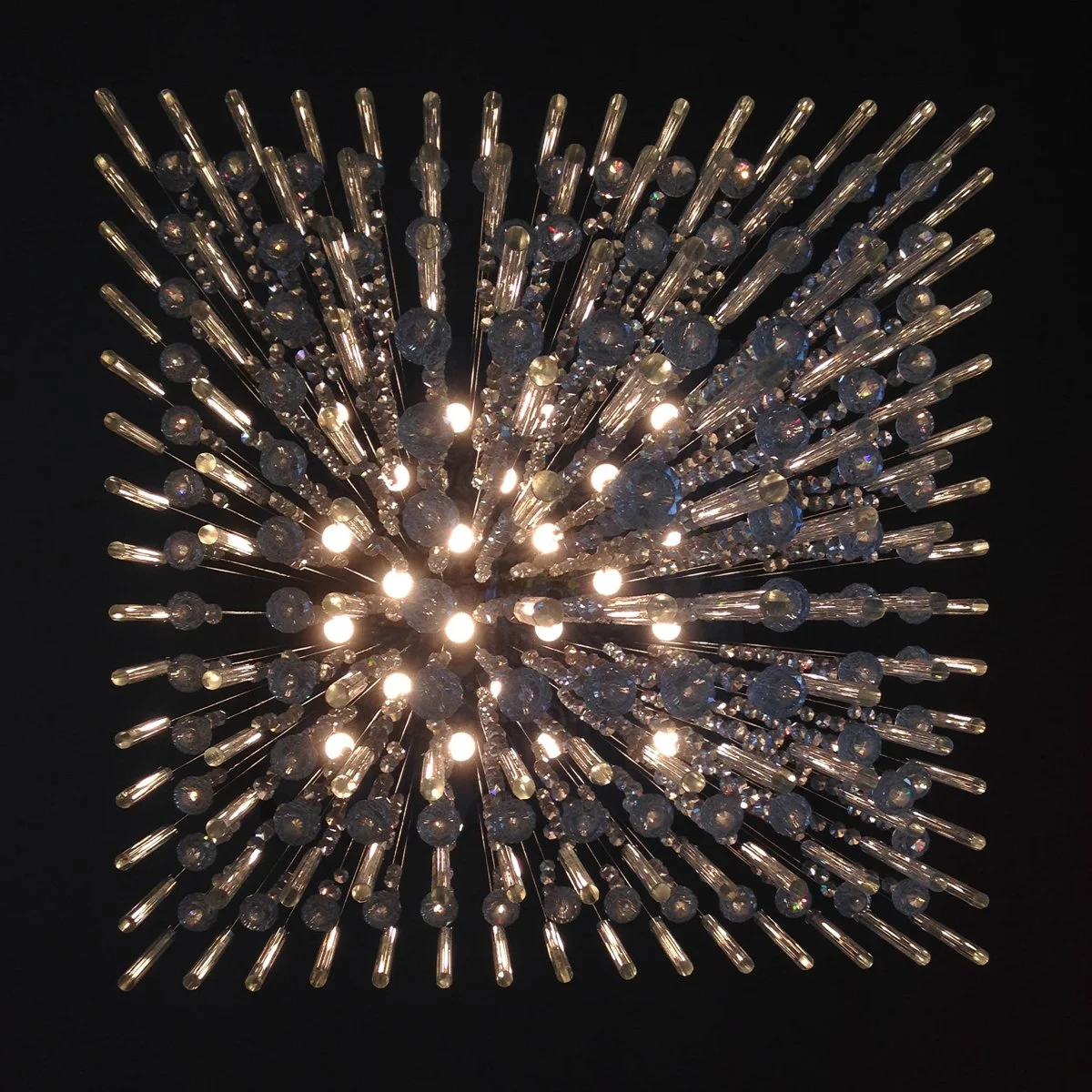
“Chrystalis” by Jennifer Weigel
Monday
He finishes the ritual perfectly on time as the clock rounds six a.m. He'll be welcomed home tonight by a sink, stove, and fridge that gleam in a kitchen reeking of food safety. Not that he'll cook in that shining room, but he will at least need to drink some water, and so, as a final touch, he double-checks his five-gallon jug, refilling it from the sink and carefully adding the recommended quarter-teaspoon of bleach (plus one or two drops—better safe than sorry) to ensure a clean supply for the next several days. He caps the bleach bottle with plenty of time left to wash, dress, and get to the office. But the lip of the shower stall stops him dead.
He disinfected the tile enclosure last night (of course) but then showered after belatedly deciding to use his home gym. The stall is rationally, objectively, still quite clean, with only possibly a molecule of his own sweat marring its sterility. And he himself is still quite clean. But he can neither enter the shower nor bring himself to dress without washing.
What lurked? How fast do bacterial colonies grow from each beastie that evades a cleaning? What insect might have commuted through the stall or across his ankle in the night?
This last idea elicits a shudder that crystallizes into a course of action. He hastily retrieves the bleach and splashes it over the floor and faucets before stepping in, huddling small beneath the water, careful to touch nothing that remains unbaptized.
He is almost late to work, then is actually late to the plan-of-the-week meeting, delayed by a water ring on his desk that necessitated immediate janitorial assistance.
Lunch is skipped, supper is selected from the produce section en route home—just enough to sustain him because leftovers (a.k.a. breeding sites) must be avoided. On the upside, he is quite slim and lean.
Tuesday
The pattern seldom varies: clean, wash, dress, work, eat, exercise, clean, wash, sleep. It is sufficient. It is calming. Each repetition reflects the control of a well-ordered life. Tuesdays, however, require care. It was a Tuesday when the sentence was pronounced, when he was released from the hospital with the caution to avoid infections. For life. The words "risk of sepsis" were used.
Avoiding the organic closeness of buses and trains, he walks to work. His apartment was chosen for proximity to the office, but it is small and for a time he referred to it scathingly as his "cell" until his bleach regimen taught him the advantages of a modest space. It is now more of a womb, a welcoming, manageable domain whose ecology can be perfectly controlled. His personal microclimate includes nothing living. Nothing that depends on the cycle of birth, growth, and decay, nothing that might rot. He cohabits only with that which can withstand a solid chlorine rinse.
On this walk, flowers catch his eye, crocuses erupting forth as a harbinger of spring and all the riotous infestations it implies. He pictures apiarian feet landing on one flower after another, transporting god-knows-what from these blooms to god-knows-where, creating a cauldron of biological potential that sends his pulse racing. Fucking Tuesday. He pulls a scarf over his nose and mouth, knowing that in another month it will be too warm for this to appear normal.
Not that he cares what others think. His family and so-called friends have abandoned him, apparently unwilling to respect his boundaries, to accommodate his requests for masks, hand washing, and so forth. Is it so much to ask? He thinks not, and yet his phone never rings, and invitations even to family holiday gatherings have dwindled since his sentencing. To hell with them all, toxic in both their bodies and their limited compassion for his blameless predicament. To abandon him after his accident—what kind of people?
He is considering relaxing his guard, bowing to the inevitability of nature and lowering his scarf for some cool air just as a young woman, late twenties, barely older than himself, bumps into him and forgets to apologize in the heat of battle to save her coffee from spillage. Blond and therefore a reminder of his doctor rather than any other women. He carefully ensures that no other women come to mind by deliberately picturing this doctor, with her blond hair and her warnings. His resolve is restored and he pulls the scarf up for a bit of extra coverage.
The doctor, the blond doctor, was attractive but not warm, and he recalls her impassivity while pronouncing judgement—eternal risk of infection. He remembers dark eyes, averted to his chart, the downturn of pouty lips—no, he catches himself, the pouty mouth belonged to another woman—and internally replays words about the spleen as a filter and a first line of defense in immune response. She was clinical and condescending and apparently unaware of her roles as judge, jury, and executioner. Lacking a spleen, she said, is normally not much of a problem but there are some bacteria—some bacteria. The word "some" haunts him. "Some" is not zero. "Some" is vague and offers no guidance. Some bacteria can kill him; hence, he must avoid all.
The doctor's face (only the doctor's face, no one else's) comes to him and reminds of this new lifestyle imposed arbitrarily upon him. It is unfair, it is lonely, but he will manage.
Wednesday
He notices the bleach taste. He must have used too much and a small part of him wonders whether another 5 parts per million will kill him. He can't sleep and considers googling whether bleach can build up in one's tissue. Remembering that too-vague and unhelpful statement of "some," he decides against it, chooses ignorance over the terror and obligations of partial knowledge.
Yet he can't sleep. The day was long, peppered with repeated reminders of spring's emergence and the imminence of human skin and sweat and hair becoming hard to avoid, exhausting him with the demands of his fragile state amidst a sea of sentient pollutants.
Insomnia degrades his will, forcing him to admit that another impulse also prevents sleep. Temptations that cannot be indulged by one committed to his course of purity. Human touch, so desired, so impossible. Blond hair and dark eyes dance before him but are soon replaced by dark hair and pouting lips. He wills those to change into the image so briefly glimpsed of a girl jostling her coffee cup—pierced nose and blue highlights. He opens his computer to search for this likeness on several professional and amateur sites, finding a selection close enough to be tempting. And he begins.
Nearing completion he stops. Urine and feces and semen and all other bodily effluents suddenly seem equally questionable. Physical release sounds as likely to result from this exercise as cholera. Adrenalized with fear he races to his small, empty, pristine kitchen to get a three a.m. start on the cleaning.
Later he sleeps fitfully and rises early, so he can afford an extended shower before work. The water trickles suggestively; pouting lips and blue highlights combine in his sleep-deprived mind; his body rebels, stiffens, under the sensual load. But his will reasserts—the temperature is raised until his eyes clench while the offending organ is not soaped or cleaned but scrubbed almost raw. He examines the abrasions that now decorate him, aware that damaged skin is susceptible to infection. He considers pouring bleach over the ulcers but decides to spare that extremity for now.
He is more forgiving to himself than the cold, blond doctor was.
Thursday
His business suit chafes on abused skin, and he longs for the weekend when he can occasionally convince himself to defer a shower in exchange for not leaving the house. Desperate and sandy-eyed, he drinks a coffee. Ten minutes later, unsure about the added milk, he considers indulging in some bulimia, but this would require proximity to a public toilet. He resigns himself to adding food poisoning to his watch list for the next twelve to seventy-two hours.
Arriving home, he tries to convince himself that self-pleasure is not risky. Only the involvement of another person—another biome—represents a roll of the dice. His pulse reflexively races at the mere thought of a sexually transmitted infection and even as he kicks himself for opening the mental door to that worry, he deploys a carefully crafted defense mechanism. Starting with Jenny from shop class, he works forward in time, reminding himself that if she had imparted any disease, it would have been detected by now. He moves forward through each partner in his history, reminding himself that he always assiduously used protection; reminding himself that he is clean.
Clean inside and out.
He is blameless, this sentence having arisen from an accident. Hand tools are dangerous. A brief misjudgment, lifelong consequences. It was a screwdriver. It was a fall. It was a fluke, to be impaled in such a way. And a blessing, really, to avoid a vital organ; people can live without a spleen. With appropriate precautions.
Precautions. Infection. His mind spirals along the confined pathways worn over the past few years, conflating safety with risk with martyrdom with purity with celibacy with death by poisoning and, unstoppable, the scene arises. An open blouse, a skirt hoisted up over a hip, the leg is attached to a girl lying on a concrete floor with dark hair above wide, dark eyes, and full lips opened into a grimace and stained with tears while she crawls, crablike, backward over the filthy surface.
The remembrance of grit and spilled oil and the slight scent of stale beer sends him to the kitchen. He drinks a tall glass of crystal clear, cold water, comforted by the taste of bleach.
Friday
He makes it to work but the grocery store would be asking too much. Fridays are also hard. His last truly healthy day was a Friday. The last time he attended a party, existing in carefree proximity to his peers. Friday is a day of grief for all that was lost: freedom, community, self-respect. He stops, resolutely confused as to why an idea of shame might have leapt to mind.
He retreats from the train of thought and instead resigns himself to a three-day fast, racing back to his spotless cell to commence the luxury of a weekend free from complications. He will clean once, as he does every Friday. He will shower gently to allow healing of the delicate organic armor that shields him from whatever pathogen might evade his other defenses.
He is exhausted and he sleeps, receiving no warning that the dream will come tonight. It is rare, visiting only when he is at his weakest. This time, it starts with him nuzzling blue hair, breathing in a female scent mixed with lavender amid a background of laughter and music. His hand slips inside a blouse, slightly open, and as he withdraws it, he pops the other buttons for greater ease of access and looks around to find himself in a garage, a filthy garage where her father is restoring his Jag, tools strewn, oil evading tarps all over the floor. Blue hair curls and darkens while lips expand, morphing her to another woman entirely. She withdraws, he rages and stiffens and trips her to the floor, taking advantage of the momentary daze when her head strikes to grab, muffle, penetrate, and his dream finally offers the release he has denied himself so long. But the dream hasn't finished; it requires payment, and he relives a second penetration, mingled with the ecstasy of mere moments ago. He stands, staggers back, to see a beautiful, distraught, disheveled girl inch backward along the floor, away from the effluent emerging beneath his left ribs, screwdriver in her hand.
He wakes and frantically assures himself that the wound is healed, has been closed since college graduation, but the images won't fade. He hastens to gather the sticky sheets, stripping the bed, washing the load in hot. He splashes the shower stall with his liquid salvation, turns on the water, but is too desperate to wait and enters it while cold, scrubbing barely healed abrasions, finding solace in each layer of skin shed, certain that with effort he will escape the chrysalis and arise new, reborn, and clean.
*
Tess Light’s work tends to incorporate any or all of the following: sarcasm, death, sarcastic death, Buddhism, foodism, poetry, song, and Shakespeare. She has won the Julie Harris Playwriting Competition, the Arts & Letters Prize for drama, and Theatre Conspiracy’s new play contest, among others, and her plays have been read in the "21st Century Voices" new play festival at American Stage and the Last Frontier Theatre Conference. Tess has recently begun exploring prose, with her work featured in long con online literary magazine and The Westchester Review. Tess lives in the high mountain desert of Los Alamos, New Mexico.
Jennifer Weigel is a multi-disciplinary mixed media conceptual artist. Weigel utilizes a wide range of media to convey her ideas, including assemblage, drawing, fibers, installation, jewelry, painting, performance, photography, sculpture, video, and writing. Much of her work touches on themes of beauty, identity (especially gender identity), memory and forgetting, socio-political discourse, and institutional critique. Weigel’s art has been exhibited nationally in all 50 states and has won numerous awards. https://jenniferweigelart.com/